


TLDR: The average professional spends more mental energy rehearsing failure than they'll ever spend rehearsing success. Not because they're pessimists. Because their brain never got the memo that the bushes stopped being dangerous. AI can fix that and almost nobody is using it that way.
Marcus has done this forty-seven times.
He knows the drive to the house by memory now.
He knows to park on the street and not the driveway, because it signals confidence without arrogance.
He knows to arrive seven minutes early and wait exactly four before knocking.
He’s been selling real estate for eleven years.
He built his own brokerage from a desk in his spare bedroom and a database of two hundred contacts he’d been collecting since his first week in the business.
He is, by any reasonable measure, good at this.
Tonight he is sitting in his car outside a $4.2 million property in a neighborhood where he has never closed a deal just outside Edgewater, NJ.
He’s about to walk in and convince two highly skeptical sellers that he is the right person to handle the most important financial transaction of their lives.
His hands are still on the wheel with the engine off.
He has been sitting here for six minutes and twenty two seconds.
His brain is already inside the house.
It’s running the part where the husband and wife crosses their arms and ask about his last three sales in this zip code and he has to explain that his track record is in adjacent markets. Then the part where they politely thank him for his time and he drives home replaying every sentence he should have said differently.
He hasn’t moved…six minutes and fifty eight seconds.
The presentation hasn’t started.
And he has already, in some meaningful neurological sense, lost it twice.
He pulls out his phone, opens ChatGPT and types: Help me prepare for this listing appointment. What objections am I likely to face?
It responds.
He reads it.
He feels, briefly, more prepared.
He gets out of the car.
He does not get the listing.
What Marcus didn't know, what almost nobody using AI right now knows , is that the tool he used to prepare was capable of something else entirely.
Something that might have changed what he walked in believing.
And belief, it turns out, is the variable that the research keeps returning to.
Here's the thing about Marcus. He's not a pessimist. He's not anxious by nature.
He is a disciplined, experienced professional who was doing exactly what his brain told him to do.
That’s the problem.
The brain’s default setting isn’t optimism. It isn’t even neutrality.
It’s threat detection, running constantly, scanning every horizon, rehearsing every possible way the bushes could kill you before you find out whether they actually will.(The ancestors who heard rustling and assumed everything was probably fine didn’t leave many descendants.)
So here we are.
Two hundred thousand years of evolution, sitting in climate-controlled cars, preparing presentations, absolutely certain something in there is about to eat us.
The trouble with that wiring is we’ve never learned to override it when the moment calls for something different.
And then AI arrived, the most powerful thinking tool in human history.
Infinitely patient and always available at 2 a.m.
And it’s amazingly capable of holding more cognitive complexity than any coach, consultant, or extremely well-read friend you’ve ever had access to.
And here’s the irony we immediately handed it the same job our anxiety already had.
Which is, and I mean this with complete respect for our collective intelligence, a genuinely impressive way to miss the point.
What Elite Performers Have Known Forever
In 1995, Harvard neurologist Alvaro Pascual-Leone ran a study that should have changed how every professional on earth prepares for high-stakes moments.
He took two groups of volunteers and taught them a simple piano sequence. One group practiced physically, fingers on keys, every day for five days.
The other group sat at a piano and only imagined playing it, same sequence, same duration, same focus, but with no actual contact with the instrument.
At the end of five days, brain scans of both groups were nearly identical.
The people who had only imagined playing had developed the same neural architecture as the people who had actually played.
Harvard called it motor imagery.
The rest of us should call it what it is: your brain cannot fully tell the difference between doing something and vividly imagining doing it.
This is a measurable neurological fact, replicated across institutions from the Cleveland Clinic to the University of Chicago, and it has profound implications for anyone who has ever sat in a car outside a high-stakes moment and let their mind run the wrong rehearsal.
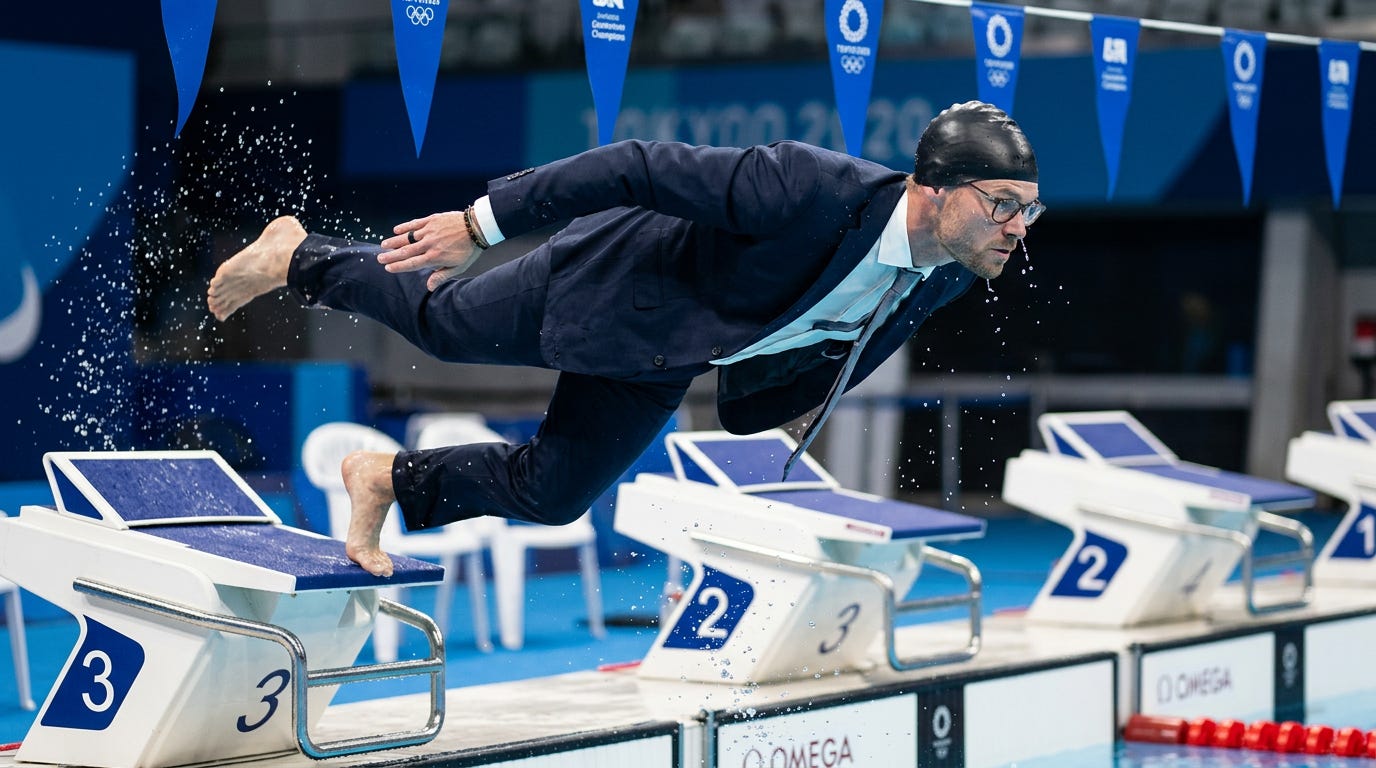
Michael Phelps understood this before he had the language for it.
His coach Bob Bowman built an entire training system around what he called “watching the videotape”, vivid, detailed mental rehearsal of every stroke, every turn, every finish, run so many times that by the time Phelps stepped onto the block, he wasn’t attempting something he was confirming it because the race was already memory.
The question Pascual-Leone’s research forces us to ask is a simple one.
If your brain is going to rehearse something tonight regardless, and it will, what exactly are you asking it to practice?
Almost none of us were taught to direct that rehearsal.
And for most of history, doing it well required a trained coach, a sports psychologist, or a genuinely rare ability to hold vivid, specific scenes in your own mind without drifting somewhere less useful.
That last requirement just got solved.
Which brings us back to Marcus.
And to you.
And to whatever you’re sitting in your car about right now.
The 3-10, Best-Case Protocol
Before we go any further, let’s be clear about what this is not.
This is not a vision board. It’s not a manifestation exercise. It does not require a journal, a retreat, or anyone in linen pants ringing a gong in your general direction. If that’s what you were worried about, you can relax.
What it is, is this: a ten-minute conversation with a tool that already lives in your pocket, built around a single instruction you have almost certainly never given it.
Here’s the instruction.
"I'm walking into [describe the situation]. Help me visualize this going exactly right. Ask me questions one at a time until the picture is specific enough to feel like a memory. Then summarize it back to me in second person, present tense.”
That’s it. That’s the unlock.
First, Set the scene. Not in soft, vague language, in concrete vivid, terms.
The listing appointment with the couple who interviewed four other agents before you.
The investor call where seven figures hang on whether you can hold the room for twelve minutes.
The conversation you’ve been rehearsing the wrong version of for three days.
Make it specific enough that the AI understands what winning looks like in this room, with these people, on this night.
Second, Answer what it asks you…Out loud, if you can manage it. Here’s why: Your brain processes spoken words differently than thoughts.
When your mouth says it, your brain hears it as something that’s already real.
That’s the whole game.
What we say out loud, our brain believes we mean.
The AI will then push you past the abstract.
What does your body do the moment you know you have them?
What does the energy in the room feel like when it tilts?
What does the other person say, and how do you respond, and what do you feel walking to your car already knowing the answer?
Stay in it longer than feels comfortable.
Third, Ask the AI to play it back in the second person and present tense.
Not “you might” or “you could.”
You walk in. You say this. They respond like this. You leave knowing this.
Read it before you go in, a few times actually.
3 steps. 10 minutes.
The only thing it costs is your willingness to spend as much time rehearsing the win as you’ve already spent dreading the loss.
Why This Actually Matters
Marcus walked into that house running failure scenarios so vivid and so rehearsed that his nervous system treated them as fact.
He was like Peyton Manning trying to throw from his back foot and land a 70 yard touchdown pass.
He was starting a half-step behind a version of himself that had practiced winning as many times as he’d practiced losing.
This isn’t a character flaw, this is just what happens when you leave the brain unsupervised before a high-stakes moment.
The 3-10 Best-Case Protocol is a redirect, using a super intelligent brain enhancer.
Same obsessive repetition your brain was going to do anyway at 11 p.m. when you were supposed to be sleeping, but this time aimed somewhere worth aiming.
Because your brain genuinely struggles to distinguish between a vividly imagined experience and a real one.
Which means the question was never whether you’re going to rehearse something tonight, you are, the only question is what.
Most people are using AI as a search engine with better grammar.
Almost no one is using it as a performance coach for their own mind.
The ones who figure that out are going to be hard to compete with because they will walk into every room having already been there.
Marcus is sitting in his car again.
Same neighborhood, same street, actually but a different house.
The possible list price is $3.8 million, half a mile from the one he lost.
His hands are on the wheel, the engine off and he is exactly seven minutes early.
But tonight, before he left his home office, he opened ChatGPT and typed something different.
He typed: I’m walking into a listing appointment with skeptical sellers in a market where I don’t have comps. Help me visualize this going exactly right. Ask me questions one at a time until the picture is specific enough to feel like a memory.
For ten minutes, he answered out loud in his car with the windows up.
What his voice sounds like when he owns the room.
What the wife’s face does when she realizes he actually understands what this house means to them.
What the husband says when he uncrosses his arms.
What Marcus feels in his chest when they slide the listing agreement across the table.
He read the summary back twice.
Now he’s sitting in his car outside the house. Four minutes and twenty-two seconds.
His brain is already inside.
This time, it’s running the version where he wins.
He gets out of the car.
This substack is so educational. We probably rehearse the negative 90% of the time. The 10% is most likely a hot contact, we know we have in the bag, so our approach is confident. Today, we have an amazing tool in AI. Thanks for this lesson. Can't wait to put it into practice.
I actually ran this for a scenario that I have coming up. Good stuff. Thank you.