


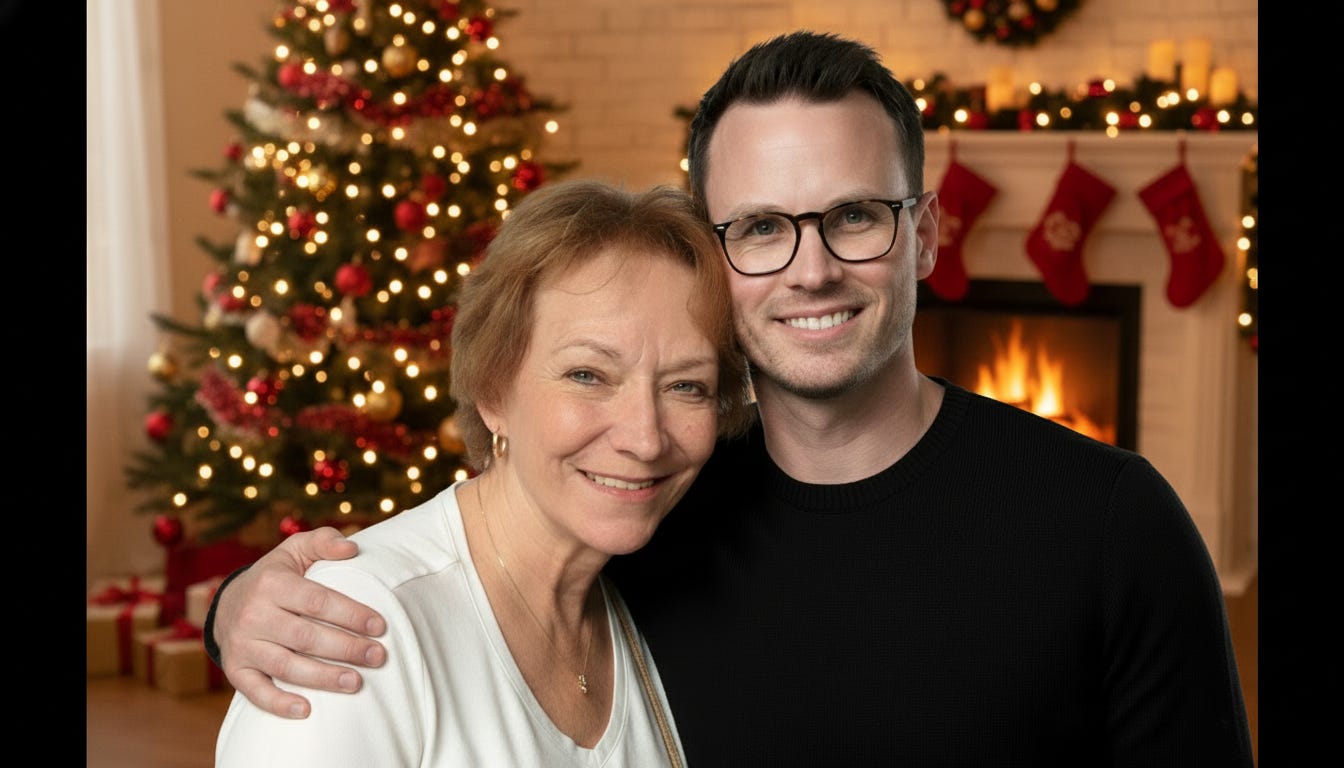
I was 13 years old when I found the note.
It was in my mom’s nightstand, underneath a stack of medical papers.
I wasn’t snooping.
I was just... scared.
My mom had just gotten the news: Stage 4 breast cancer. Very aggressive.
And family I hadn’t seen in years were suddenly flying in from all over the country. The vibe in our house was... heavy.
I was a kid, but I wasn’t stupid. I knew what this meant.
I went into her room, I got upset, and I found it. A note, with my name on it.
It was a goodbye letter.
A letter for me to read after she passed away.
(Spoiler: that cancer didn’t end up getting her. She beat it. She was a badass. But in that moment, neither of us knew that.)
I remember my world just... shattering.
A few days later, I took the New Jersey Transit train to Philadelphia to see her at the Hospital of the University of Pennsylvania. I’m 13.
I’m holding this apocalyptic secret of the letter.
I’m walking into a cancer ward. I’m bracing myself for the “Big Talk.” The somber, serious, “here’s what could happen” speech.
I sit on her hospital bed. The room is quiet.
I’m trying not to cry. She looks at me. I look at her.
She stops, looks at the tray of hospital food on her table, and points. “You know,” she says, “this Jell-O... it’s just... sad.”
I was confused.
And then she started laughing.
She started talking about the absurdity of the gray-looking mystery meat, the profound sadness of the Jell-O.
She knew I was terrified. She knew the stakes. She knew she might not make it.
But in that moment, she taught me the single most important lesson of my life.
She wasn’t ignoring the darkness.
She was just refusing to let it win. She was showing me that you can be terrified and you can still find the humor.
You can be in pain and you can still find the perspective.
In my grief, in my tears, she gave me the Permission to Laugh.
That principle is the baseline of my entire life.
It’s how I survived the “crazy contrast” of my childhood—being a 13-year-old professional actor on a high-pressure TV set by day, and a grieving kid in a hospital room by night.
It’s how I built an ad agency in New York City from scratch and sold it.
It’s the core of what I teach as a coach to thousands of entrepreneurs.
Because we’ve all been sold a lie about resilience.
We’ve been told it’s about “grinding.” It’s the #RiseAndGrind, “sleep when you’re dead” hustle-bro fantasy.
That’s not resilience. That’s a one-way ticket to burnout.
True resilience isn’t perseverance. It’s perspective.
Resilience isn’t how hard you can grind. It’s how fast you can find the humor in the hard.
The “grind” is just you absorbing the stress.
The “laugh” is you reframing it.
It’s the emotional jiu-jitsu that lets you take the force of a bad day and redirect it. It’s the perspective shift that moves you from a place of “lack” (this is terrible) to a place of “gratitude” (I’m still here).
It’s the principle that separates high-performers from people who just... break.
So, how do you do this when you’re in the middle of your own dumpster fire?
Here’s the playbook.
The 3-Step “Permission to Laugh” Playbook
(A practical guide to my mom’s lesson)
1. Acknowledge the Absurdity (The “Hospital Food” Step).
The next time you’re in a “this is the end of the world” spiral, I want you to stop and just... look at it.
Your biggest client just canceled. Your launch failed. Your kid just drew on the new sofa with a permanent marker.
It’s not just bad. It’s hilariously bad. It’s a scene from a sitcom.
Give yourself 10 seconds to acknowledge the sheer, comical absurdity of the situation.
2. Find the “1% Funny” (The “Sad Jell-O” Step).
You don’t have to find it all hilarious. Just find one percent. Is it the look on your own face?
Is it the fact that this happened on a Tuesday? Is it the memory of your mentor telling you this exact thing would happen?
Finding that 1% crack of humor is the first step to getting perspective. It’s the light that gets in.
3. Reframe the Story (The “Gratitude” Step).
Once you have perspective, you have power.
You can stop being the victim of the story and start being the author of it.
The “grinder” asks, “Why is this happening to me?” The “performer” asks, “How am I going to tell this story later?”
That’s the shift. That’s resilience.
The world will always be hard.
Your job isn’t to be tougher than the world.
Your job is just to find a better perspective.
In Your Corner - Drew
Powerful! The message and the story. She sounds like an incredible woman!
You're a lovely writer, Drew. And she gave you quite the gift with that lesson