



Someone asked me a question this week that I haven’t been able to shake.
“If AI can make anyone an expert…what happens to the dream?”
I didn’t really know how to answer and then he continued….
“The capitalism dream, the one we all grew up on…the deal we were told was the deal:
You work hard.
You get good at something.
You earn more money.
You buy a better life….”
That equation has been running for generations.
And for the most part it works, not because it was fair, but because it was sequential. You couldn’t skip steps and expertise took years.
Years created scarcity.
Scarcity created value. (or perceived value)
AI just put a blowtorch to the middle of that sequence.
The Old Equation
Here’s how the dream was supposed to work, let’s call it The Effort Escalator.
You started at the bottom fresh out of the college with the greatest football team in the world… The Ohio State University.
You didn’t know anything so you put in the reps. Nights, weekends, bad clients, worse bosses. (God I feel that last one)
Slowly, painfully, you built expertise →
That expertise made you more valuable →
More value meant more income →
More income meant a better life.
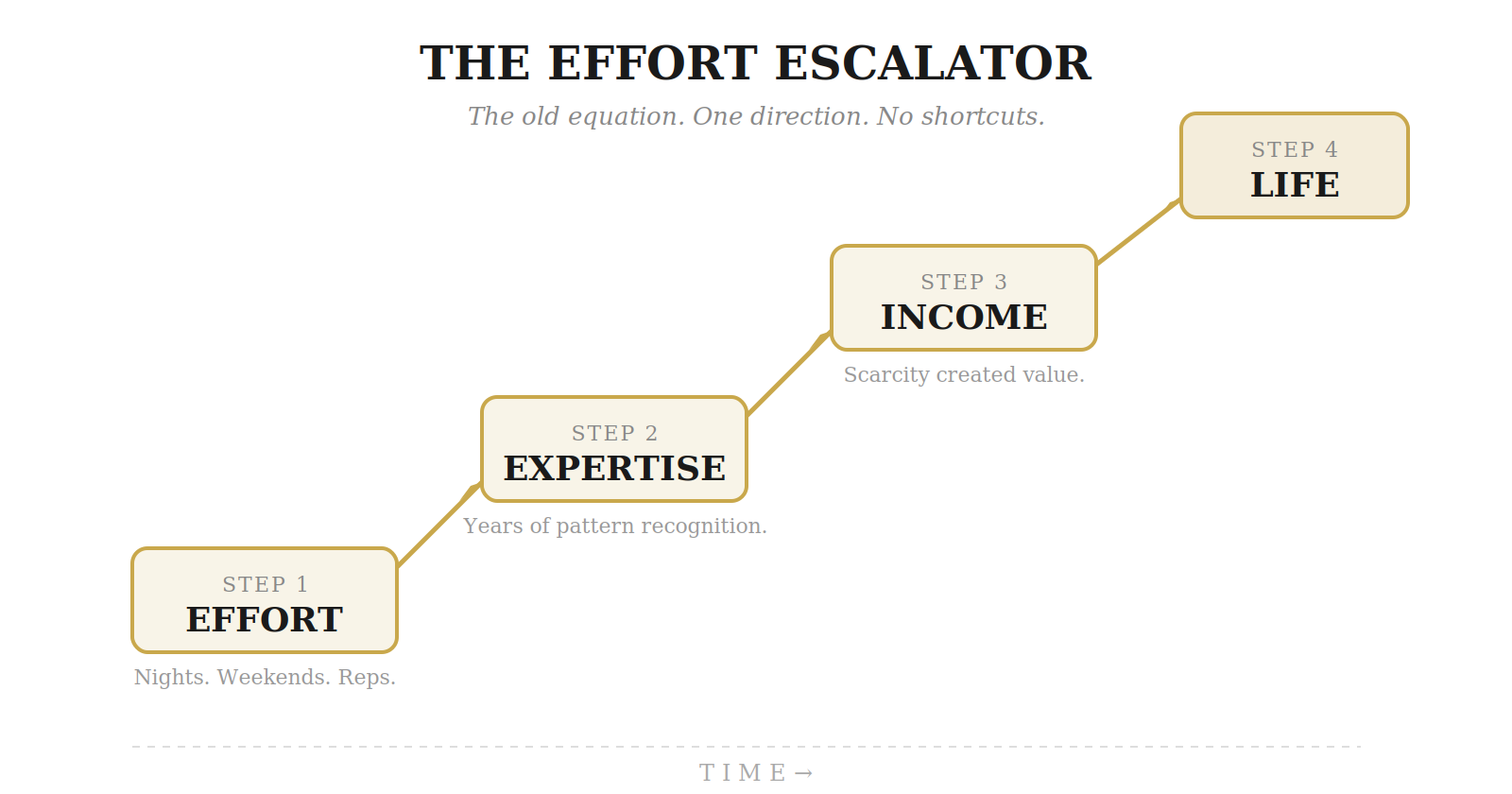
The escalator only moved in one direction: up. and a ride take 10-15 years.
That was the feature, not the bug. The time it took to develop expertise was the moat. It’s what kept your competition behind you and your income ahead of theirs.
This is why your parents told you to go to college or why your boss told you to get your MBA.
Why you sat through 47 webinars on “mastering the algorithm” last year.
Every rung on the ladder was built from one raw material:
Time converted into knowledge.
The Collapse
Here’s what happened.
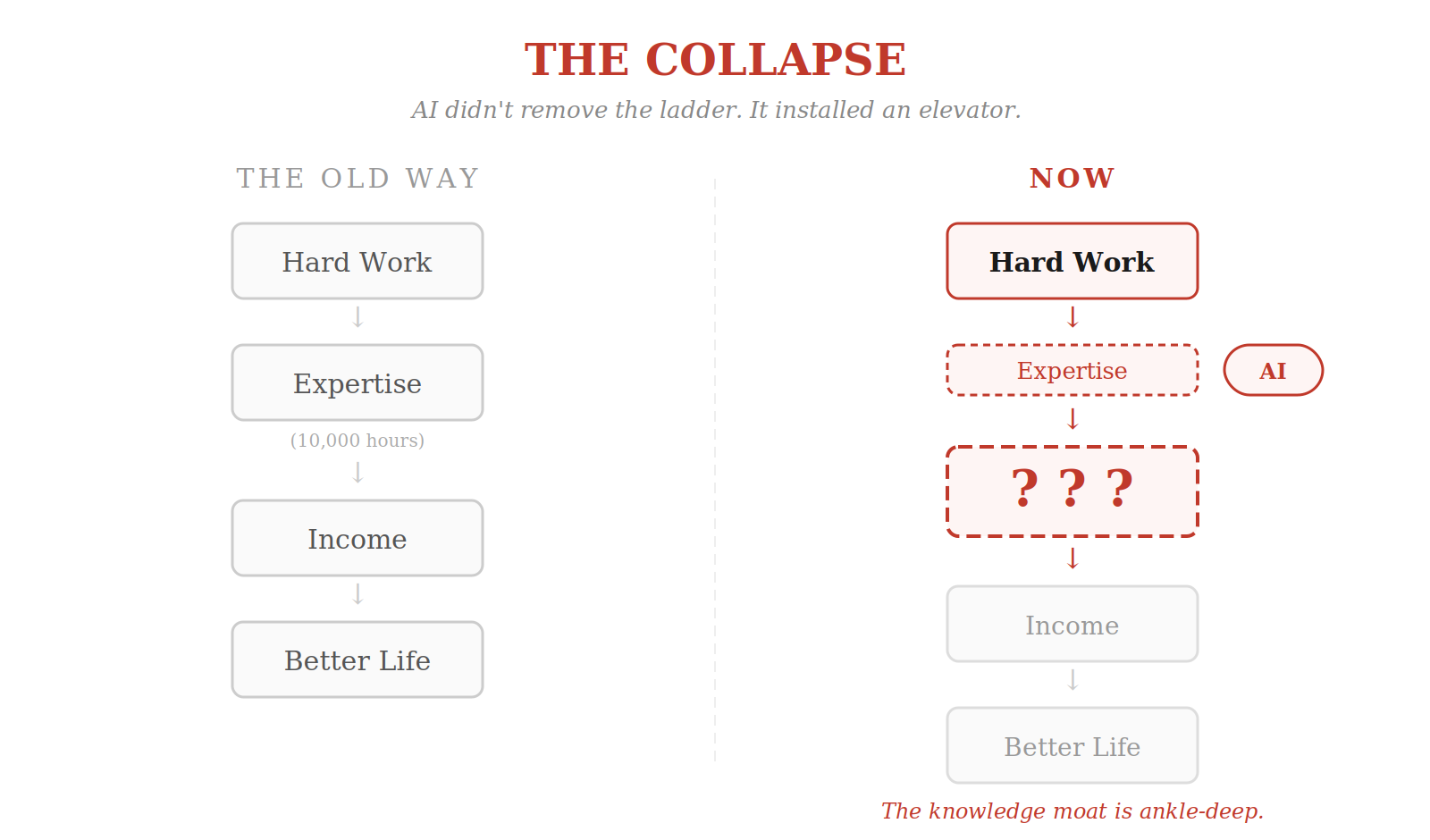
AI didn’t remove the ladder, it simply installed an elevator next to it.
A 23-year-old with ChatGPT Claude can now produce a market analysis that would’ve taken a McKinsey associate three weeks.
A solo real estate agent can generate listing presentations, client communications, and neighborhood research at a speed that used to require a team of five.
A first-year employee can write code, draft contracts, and build financial models that previously required a decade of pattern recognition.
The knowledge moat, it’s ankle-deep now.
And if expertise is no longer scarce, then the old equation breaks:
Hard work → Expertise → Income → Life becomes Hard work → ??? → Income → Life.
That missing middle is what’s keeping people up at night. (or maybe just keeping me up at night because I obsess over what type of world my kids are walking into)
The Part Nobody’s Talking About
Here’s what the “AI is going to take your job” crowd gets wrong.
They think the equation is dying. It’s not. I believe it’s evolving.
The variable that changed isn’t effort.
It’s what effort gets converted into. (stick with me here)
In the old economy, effort converted into competence…aka…
How much do you know? How fast can you execute? How many years of experience do you have?
In the new economy, effort converts into conviction…aka
What do you believe? What will you stake your name on? What decision will you make when the AI gives you five options and all of them look right?
I call this The Conviction Economy.
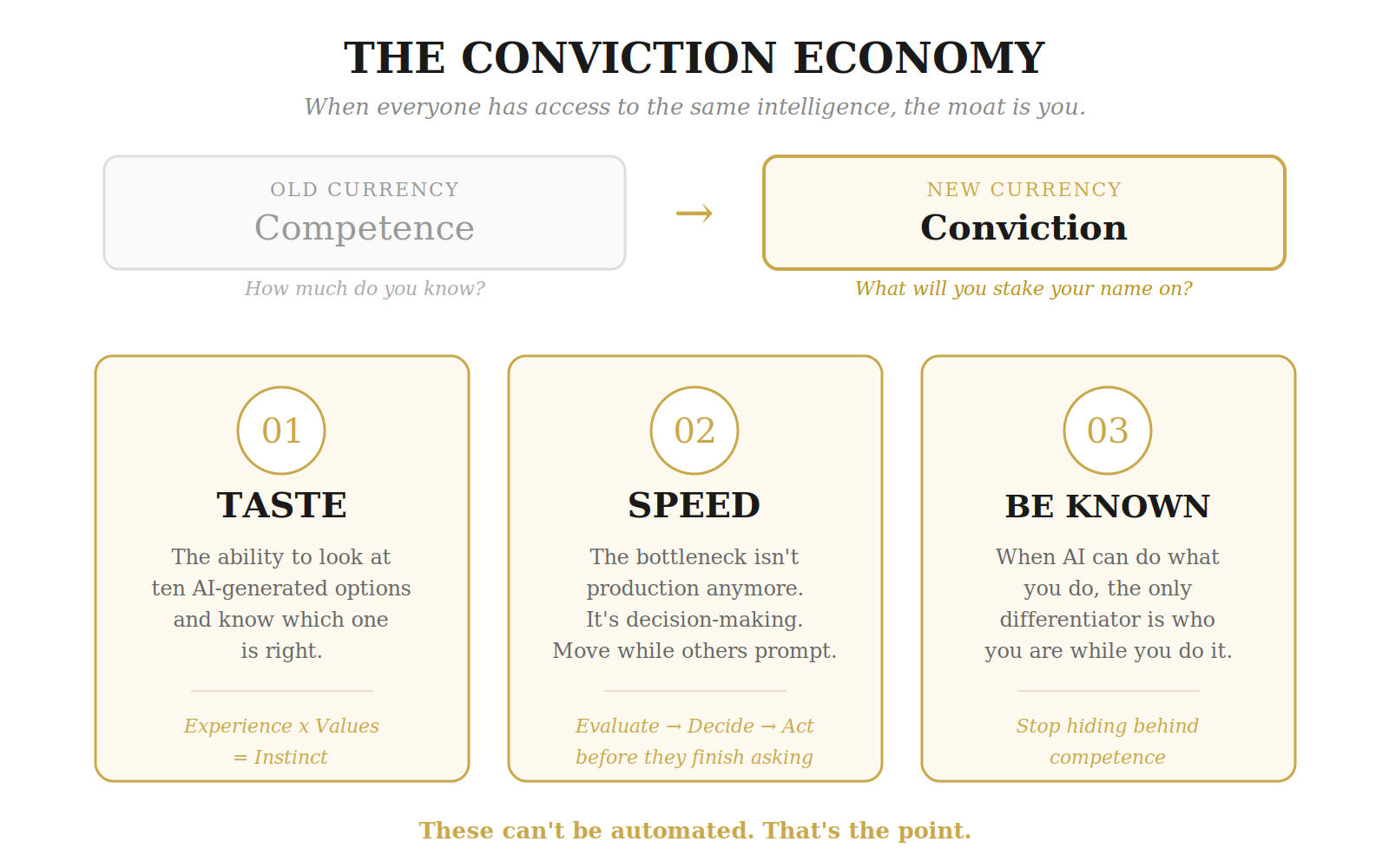
Competence is now table stakes, because everyone has access to the same intelligence.
The same tools. The same answers.
What they don’t have access to is your judgment.
Your taste. Your willingness to pick a direction when the data says “any of these could work” and commit to it with your whole chest.
This is the new moat and it has nothing to do with AI.
Three Things That Actually Matter Now
If the Conviction Economy is real, and I believe it is. then three skills become disproportionately valuable:
1. Taste.
Not aesthetic taste (though that helps)…Decision taste.
The ability to look at ten AI-generated options and know which one is right. not because the data says so, but because you’ve developed an instinct that no model can replicate.
Taste is the residue of experience filtered through values.
AI has experience but it doesn’t have values.
2. Speed of Decision.
In a world where everyone can produce expert-level output, the bottleneck isn’t production, it’s decision-making.
The person who can evaluate, decide, and move while everyone else is still prompting…wins.
Not because they’re smarter, but because they’re less afraid of being wrong.
3. The Willingness to Be Known.
This is the big one.
When AI can do what you do, the only differentiator is who you are while you do it. Your name.
Your face…perspective…your weird, specific, only-you take on the world.
The people who win in the Conviction Economy are the ones who stop hiding behind their competence and start leading with their identity. In the Conviction Economy, those who operate under the “fame is the most efficient business model” of Sharran Srivatsaa will win…disproportionately.
So What Happens to the Dream?
It doesn’t die IMO…it grows up.
The old dream was: work hard, get good, earn more, buy things.
The new dream is: work smart, know yourself, stand for something, build a life that actually looks like you.
The Effort Escalator only promised material returns.
The Conviction Economy promises something the algorithm can never touch:
Meaning.
The hustle isn’t dead but what you’re hustling for has to change. Because if you’re still grinding to become the smartest person in the room, I have bad news…
The room just got a lot smarter than you.
The question is whether you’re interesting enough to still be invited.
There is one word that you used that is a moat: Judgment. This is where AI fails miserably because it does not have the judgment which comes with experience. That in itself does not guarantee success. Those resting on their laurels will not succeed. Anyone who can see the writing on the wall is building better systems than just the LLMs offer. This is where judgment and experience still have value
Great article. And yes, I grew up having the old way drilled into my head. The worst part about the new way is that AI is evolving so fast, always coming up with a ne one to try, to learn, etc. It seems endless.