


I pick up Landon at 5:00.
Not around 5:00.
At 5:00.
Because at 5:05, the daycare starts charging me ten dollars.
At 5:10, it’s twenty.
By 5:15 I’ve spent more on late fees than I did on lunch, and a very patient woman at the front desk is giving me the look that says she had somewhere to be twelve minutes ago.
So I am there at 5:00.
Then I get Everly and Hunter, and by 5:15 all three of them are loaded in the car and someone is already yelling about who touched who, and I am pulling into the driveway of our house in New Jersey with roughly the same cortisol levels as a man defusing an explosive. (I felt my heart rate go up just reliving that experience from this afternoon)
Here is what happens next.
I get the kids out.
I bring in the backpacks.
I bring in the lunchboxes.
I bring in the one shoe that somehow came off between the car and the front door.
And then I walk my phone into my office.
Not my pocket.
Not the kitchen counter where I can still hear it buzz. The office.
That is where it stays until the kids are in bed.
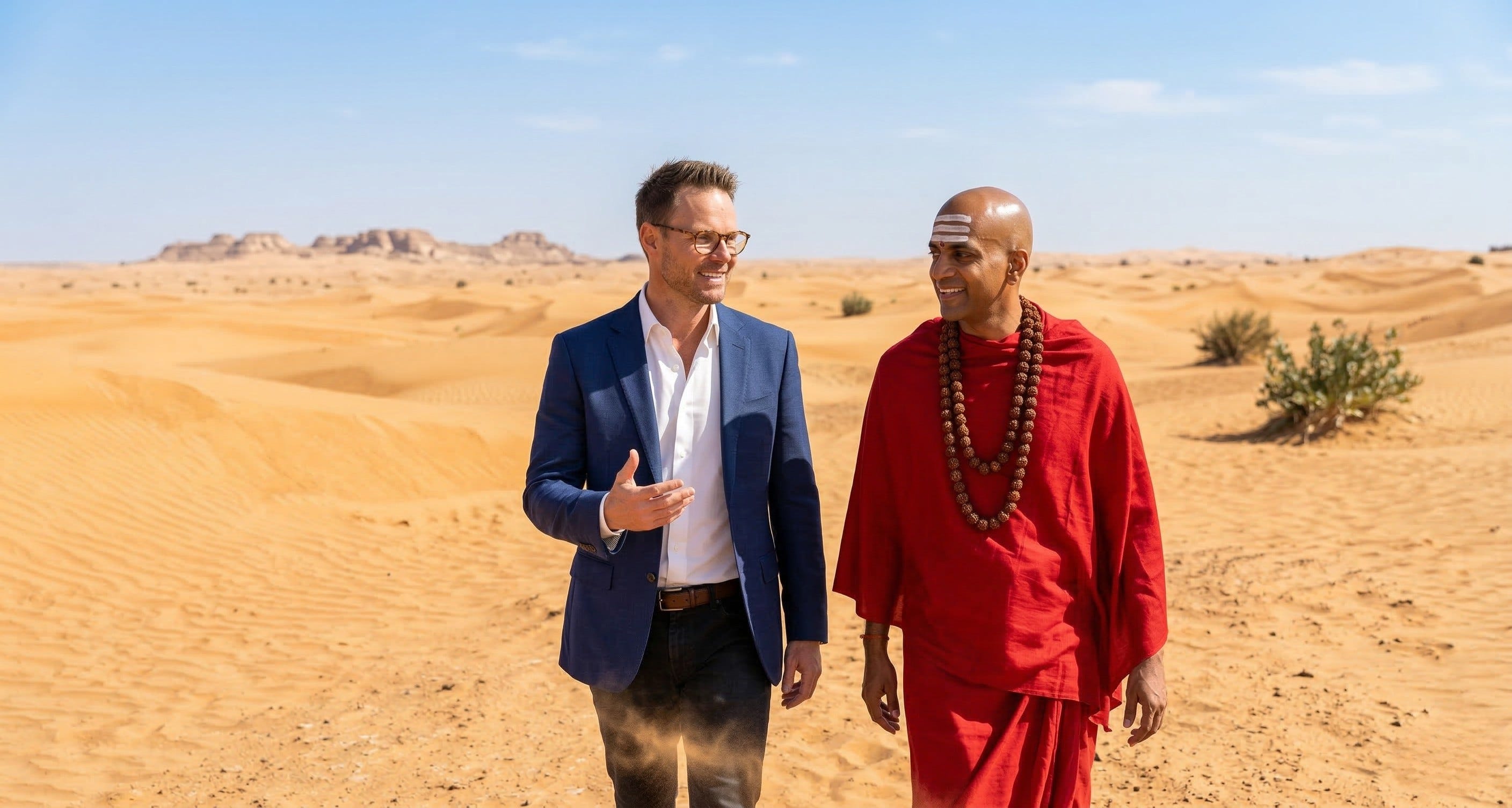
A Hindu priest taught me this. His name is Dandapani.
He spent ten years as a monk in a monastery in Hawaii, left, got married, and now teaches entrepreneurs how to focus.
A few years ago. I was standing backstage at an event in Vegas with him and Sharran Srivatsaa and he said something that I have not been able to unhear.
I’m paraphrasing, but it went something like this:
You use the bathroom in the bathroom. You don’t bring it with you to the living room. Your phone is for your office. Leave it there.
The first time I heard that I laughed.
The second time I thought about it, I stopped laughing.
Because he was describing a boundary so obvious that the only reason nobody follows it is because we’ve been trained not to.
So I started following it.
And that one decision broke something open in how I think about every AI tool I use.
UC Berkeley published a study last month that found AI is producing the opposite of its intended effect in a significant number of workplaces.
Not a slight miss., the opposite.
Instead of freeing people up, the tools are creating a new form of cognitive overload.
More dashboards and more micro-decisions about which tool to use for which task and whether the output is even worth the prompt you wrote to get it.
The researchers concluded that organizations need to do something radical: protect windows of uninterrupted focus and prioritize human connection over further automation.
Read that again.
The researchers studying AI’s impact on work said the fix is more humanity.
Then there is Klarna, the Swedish fintech company that became the industry’s poster child for going all-in on AI customer service. They cut hundreds of human support jobs and replaced them with bots.
Customers revolted because the bots could not handle nuance or read emotional tone. Klarna reversed course, started rehiring humans, and their CEO publicly admitted the cuts had gone too far.
I bring this up not to argue against AI.
I make my living helping people adopt it.
I bring it up because most professionals are doing a quieter, slower version of the same mistake Klarna made.
They are automating things that should not be automated and adding tools that create more work than they eliminate.
They are mistaking activity for progress.
AI can help you become more human if you use it in the right way to free your time to be present and really be where your feet are.
There was a stretch last year where I had accumulated so many AI tools that managing my stack felt like a second job layered on top of the first one.
I had a CRM with AI scoring.
A scheduling bot.
Open Claw (turns out it just crashes all the time and costs way to much money making pulls from Claude when it could use an SLM and be more efficient IYKYK)
A video editor.
An email sequencer running A/B tests I barely had time to read the results of.
My setup was impressive if you saw it on a screen but in practice, I was spending more time feeding the system than doing the work the system was supposed to free me up for.
I would bet you may be in a similar situation.
My wife Meg said something during that stretch that I still think about.
She said I was there…but I wasn’t there.
She was right.
I was sitting next to her on the couch, physically present, mentally distributed across six SaaS platforms.
My body was home and my eyes were watching Bluey for the fortieth time but my attention had not left the office.
Which is ironic, because my phone had.
That is the thing about tools without boundaries. They follow you everywhere.
Into the living room while your daughter is trying to tell you about her day
Into bedtime when you should be reading a book in a funny voice and not thinking about your open rate.
So I built a hard boundary, and then I built a filter.
I call it The Drawer Test, and it works like this.
You list every AI tool you touch in a given week.
Then you ask one question about each:
Does this tool earn back more time or money than the attention it actually costs me?
Not the attention the sales page said it would cost.
The real cost. The context switching. The notifications. The twelve minutes you spend adjusting a prompt when you could have just written the email yourself. (I know this line resonated with more than half of you reading)
Then you cut half the list.
I cut six tools when I ran this and my output did not drop.
My focus sharpened and my creative work, the writing and speaking and coaching that actually drives my business, got measurably better.
It turns out your brain does interesting things when it has room to think.
But here is the part of the filter that matters most, and it’s the part most productivity advice skips entirely.
You have to decide what the tools are not allowed to touch.
For me, that’s 5:00 PM to 8:30 PM.
Bedtime with Landon does not get a workflow.
The hour I spend with Hunter and the conversations Everly wants to have about her day do not get optimized or automated or fed into some system.
Those aren’t inefficiencies waiting to be solved, they are the whole point of the rest of it.
Harvard published research recently showing that 94 percent of people want AI to help humans do their work, not replace them.
The market is telling you exactly what it values.
It values someone who can use the technology and still be fully present with the people in front of them.
The competitive advantage nobody is selling you is not a better tool.
It’s margin.
The space to actually be where you are, doing what you’re doing, with the people who are right there.
This is what I mean when I say, AI makes us more human.
Dandapani left a monastery to teach people how to focus.
The simplest thing he teaches is that you should leave your phone where your phone belongs.
Every day at 5:00, I pick up my son.
I load three kids into a car.
I pull into my driveway.
I bring in the backpacks and the lunchboxes and the one shoe.
I walk my phone to my office and I close the door.
And then I go be a dad.
Not a distracted version of a dad who is also checking Slack.
The real one.
The version of me my kids will actually remember.